

The Assault on Science in the USA and its Implications for Innovation and IP
In November 1944, President Franklin D. Roosevelt wrote to Vannevar Bush, then head of the United States National Defence Research Committee (NDRC), which coordinated and led American science during World War 2. Acknowledging that the NDRC represented “a unique experiment of team-work and cooperation in coordinating scientific research and in applying existing scientific knowledge to the solution of the technical problems paramount in war”, Roosevelt wrote that there was “no reason why the lessons to be found in this experiment [could] not be profitably employed in times of peace”. He tasked Bush to find the way.
In July 1945, Vannevar Bush sent his justly famous report, entitled Science the Endless Frontier, to President Truman who had by then succeeded Roosvelt following the latter’s death several months earlier. The Report recommended that the Government “should accept new responsibilities for promoting the flow of new scientific knowledge and the development of scientific talent in our youth”, as well as “the opening of new frontiers”. It proposed the creation of a new agency to oversee the effective discharge of these responsibilities.
It took some five years and considerable discussion and debate, mainly about different approaches to government sponsorship of science, rather than the basic idea of such sponsorship[1], before Congress passed the bill creating the National Science Foundation (NSF). In his statement on signing the bill, President Truman noted that “We have come to know that our ability to survive and grow as a Nation depends to a very large degree upon our scientific progress. Moreover, it is not enough simply to keep abreast of the rest of the world in scientific matters. We must maintain our leadership.”[2]
Since those beginnings, public funding for basic science has enjoyed continuous and largely bipartisan support in the USA and has been an integral part of the successful science and innovation ecosystem of the country. In a poll conducted in January 2025, for example, a large majority of Americans considered that basic science research was necessary and should be supported by the federal government.
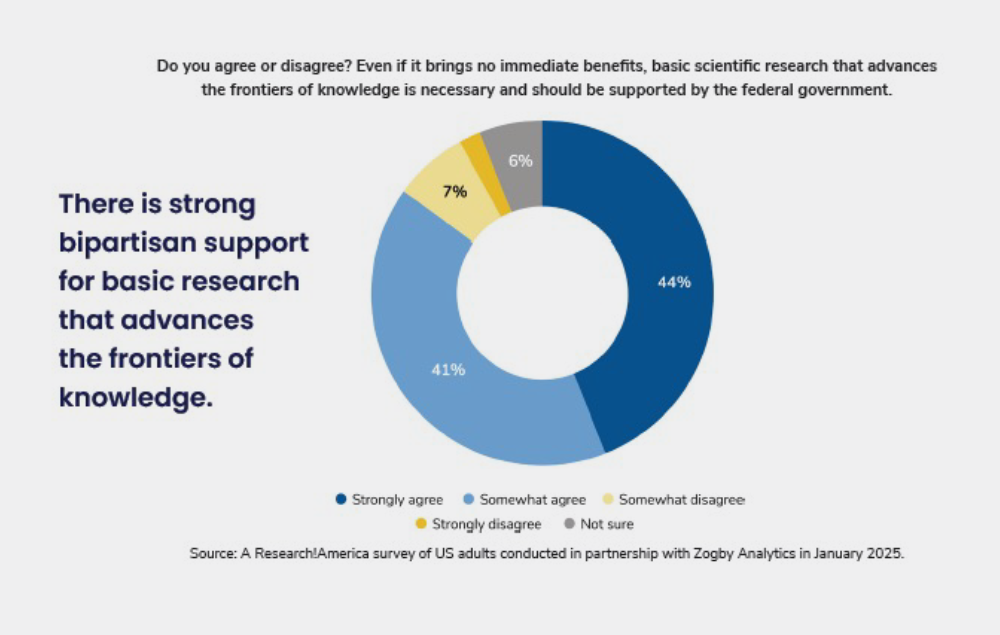
From Vision for American Science & Technology, Unleashing American Potential
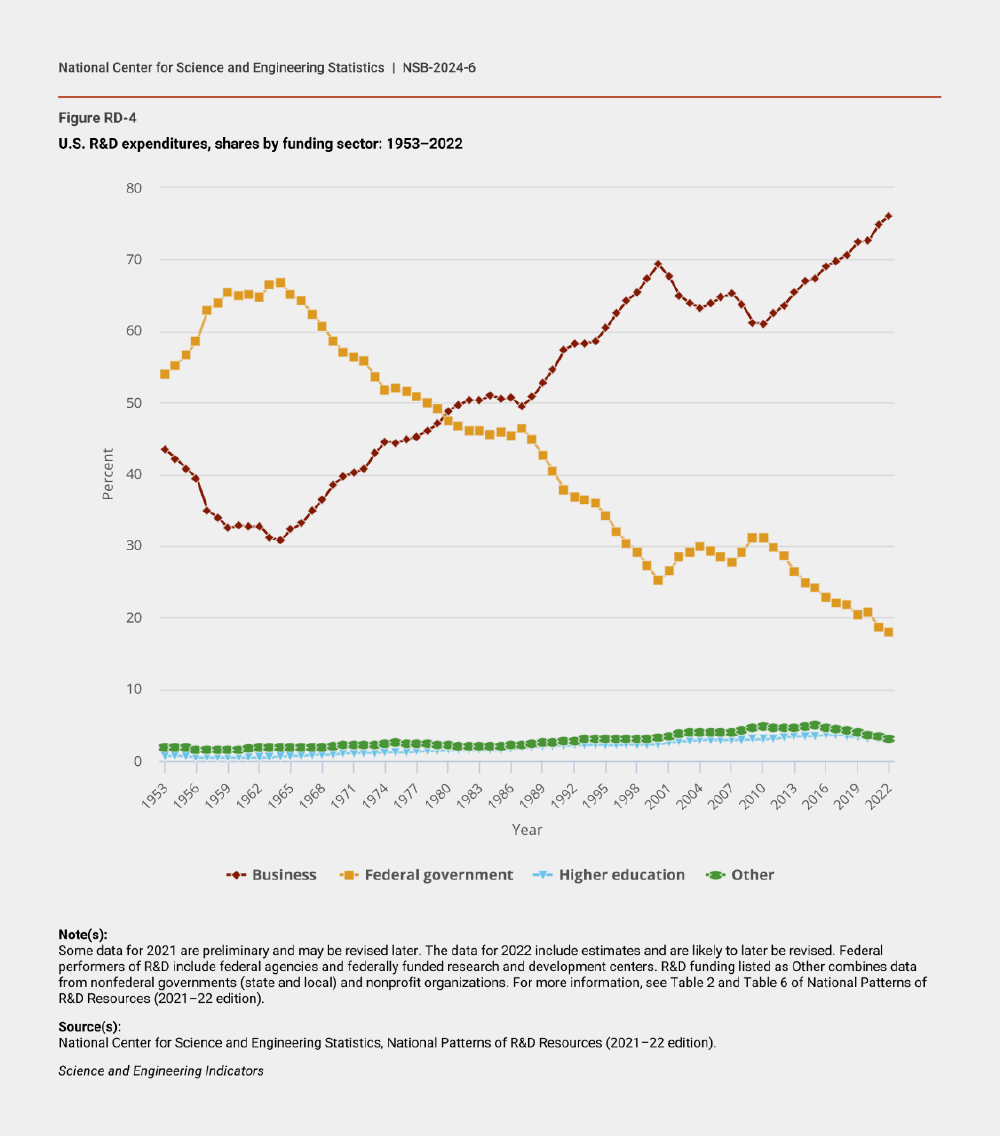
In 2022, total R&D expenditure in the USA reached USD 885.6 billion. The Federal Government’s contribution to this total was USD 159.8 billion or 18% of total R&D funding.
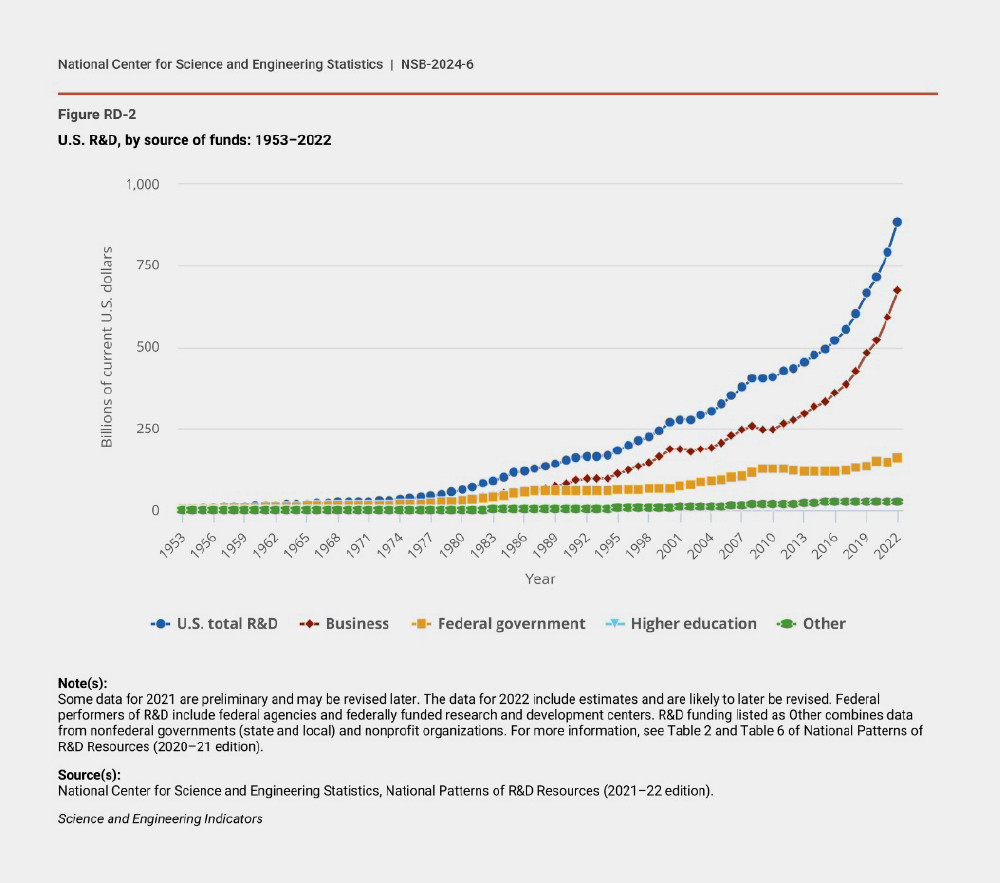
While being the largest contribution of federal funding in dollar terms since 1953, this amount nevertheless represented a declining share of total R&D expenditure in the USA as business expenditure and, consequently, the business share have soared in recent years. Importantly, however, while federal funds represented only 18% of US R&D, they accounted for 40% of funding of US basic research.[3]
For obvious reasons, government funding for basic research is both necessary and vital and, very often, is the only such funding source. Basic research, not having an immediate market orientation or application, is less likely to attract finding from the private sector whose R&D efforts tend to be focused on the application, development or adaptation of the results of basic research to perceived market needs or opportunities.
Federal funding of basic research in the USA has, over the years, produced a large number of spectacular advances that have been transformed into highly successful market innovations. Amongst the major breakthroughs that were supported by federal funding are the foundations of the Internet, GPS, the Google Search Engine, LED lights, magnetic resonance imaging (MRI), Hepatitis A vaccine, Hepatitis B vaccine, barcodes, hybrid corn, lactose-free milk and many others.[4]
Given the consistency of the policy of federal funding of basic research, it came as a significant surprise, if not shock, when President Trump altered the course of this long-standing policy by drastically cutting federal funding for basic science and for the NSF early in his second administration. It is difficult to put a precise figure on the extent of the funding reductions since the process is ongoing and litigation is underway contesting many of the cuts. Nevertheless, it can be said with considerable certainty that the reductions are major and drastic, that they are having and will have a very significant impact on basic science and its funding and performance nationally, in the USA, and internationally, since the USA was also major funder of basic research outside the USA, and that the consequences for science and innovation geopolitically are also likely to be major.
To give an idea of the magnitude of the reductions in US federal funding for basic science, the American Association for the Advancement of Science (AAAS) calculated that, for basic science research, the overall budget would fall to USD 30 billion from USD 45 billion, a drop of roughly 34 percent[5].
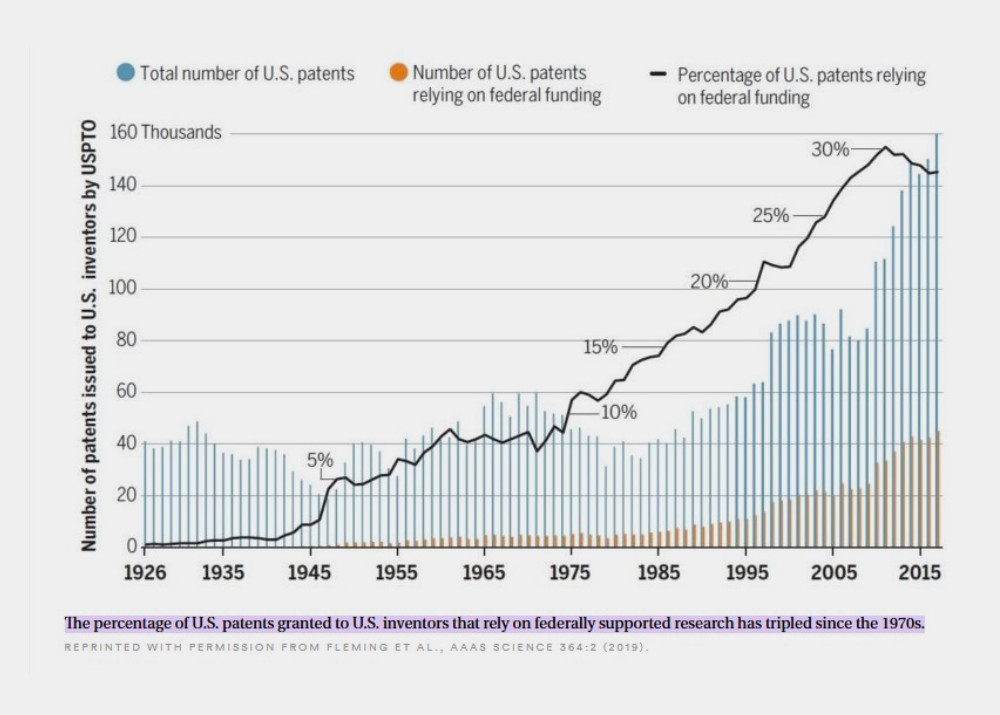
A first consequence of this reduction in funding will be a decrease in output, usually in the form of scientific articles and patents, that rely on federally funded basic research. In a study[6] of US patents between 1926 and 2019, published in Science in 2019, the authors found that one-third of US patents relied on scientific knowledge, in the form of scientific papers and patents, generated by federally funded research.
A second consequence will be the negative influence that the funding reductions will have on elements of the US innovation ecosystem that are indispensable to the health and effectiveness of that system. First and foremost in this respect are the scientists and researchers. Considerable uncertainty has been created for both institutions and researchers as a consequence of the reductions and their uncertain status amid the processes of both litigation and congressional approvals. In January 2025, over 50,000 scientists and their supporters signed an open letter asking Congress to safeguard federal research and scientific jobs ahead of the incoming Trump administration[7]. The radical step of emigration is under active consideration or underway by many.
For decades, the USA and its research institutions and universities have attracted the top scientific talent from all around the world, with relatively generous salaries, first-class institutions and facilities and relatively abundant research grants and funding. In March 2025, the journal Nature reported that 75% of the scientists who responded to a poll that it conducted (some 1600 persons) said that they were considering leaving the USA and looking for positions elsewhere[8]. Other countries were quick to seize the opportunity of attracting such potential talent. Specially designed programs aimed at luring US-based scientists to their institutions were deployed or planned in Australia, Canada, China, France, Germany, Republic of Korea, Spain, United Kingdom and many other countries[9].
In addition to the uncertainty and alarm created by funding cuts, further turmoil has been created by the perceived political oversight of the process of funding grants and reductions. This has affected, in particular, medical research, where vaccination programs and mRNA vaccine research have been halted or stalled. Additionally, funding in the areas of environmental science and diversity, equality and inclusion (DEI) has been stopped or affected.
It is still early days in the second administration of President Trump and certainly too early to hazard any guesses about the longer-term impact of the assault on basic science. It needs to be remembered also that private funding of R&D in the USA has been steadily rising compared to public funding, as indicated above. The Trump approach certainly favours the former. But, as also noted above, private funding rarely addresses areas of market failure, such as orphan diseases, or blue-sky research.
One area where one can say with some confidence that the longer-term impact will be significant is the geopolitical competition between the USA and China, which is increasingly focussed on science, technology and innovation. As is apparent from all indicators, China’s rise in science, technology and innovation has been, and is, inexorable. In the area of R&D, it is rapidly approaching the USA in the level of investment.
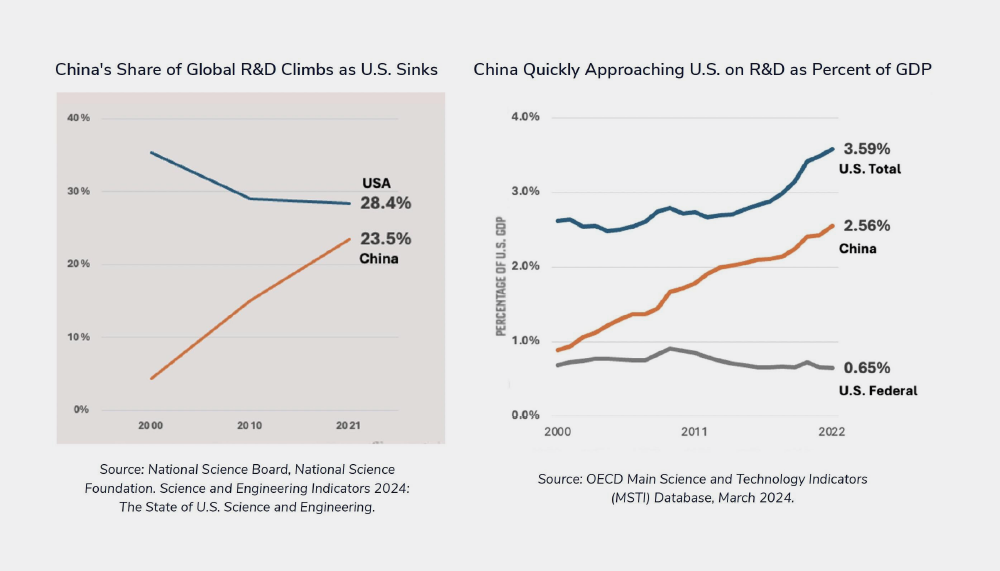
China has, until now, invested less in basic science as a component of overall R&D, but this, too, is changing. In 2024, investment in basic research climbed 10.5 % from 2023 to 249.7 billion yuan, which accounted for 6.91 % of the total R&D expenditure, marking an increase of 0.14 percentage points[10]. In the Government Work Report submitted in March 2025 to the national legislature, it was indicated that China would further increase the allocation to basic science of total science and technology expenditure[11].
In the Editor’s Journal in the Summer 2025 edition of Issues in Science and Technology, the journal of the US National Science Foundation, Lisa Margonelli pointed out that the 80 year old report of Vannevar Bush had been mentioned 16 times since 2015 in the New York Times, nine of those in the last six months. Recent titles of articles, she noted, included “US Scientists Warn that Trump’s Cuts Will Set off a Brain Drain,” “White House Tech Bros Are Killing What Made them (and America) Wealthy,” and “The End of the University as We Know It.”
There have been many hugely significant decisions and new directions taken by the second Trump Administration in the short space of nine months. The change in direction of funding for basic science may well prove to be, in the long-run, one of the most fateful of them all.
[1] National Science Foundation (George T. Mazuzan), The National Science Foundation – A Brief History, https://eric.ed.gov/?id=ED361191
[2] https://www.trumanlibrary.gov/library/public-papers/120/statement-president-upon-signing-bill-creating-national-science
[3] The graphs and figures are taken from National Science Foundation, Science & Engineering Indicators 2024
[4] See, for example, Information Technology & Innovation Foundation (Peter L. Singer), Federally Supported Innovations: 22 Examples of Major Technology Advances that Stem from Federal Research Support https://www2.itif.org/2014-federally-supported-innovations.pdf
[5] William J. Broad, Trump Seeks to Cut Basic Scientific Research by Roughly One-Third Report Shows New York Times 10 July 2025
[6] Fleming L., Greene H., Li G., Marx M. and Yao D., “Government-Funded Research Increasingly Fuels Innovation” (2019) 364 Science 1139-1141
[7] See Chelsea Harvey and E&E News, “50,000 Scientists Urge Congress to Protect Research from Trump” in Science 14 January 2025
[8] See Alexandra Witze, “75% of U.S. Scientists who Answered Nature Poll Consider Leaving” Nature 27 March 2025
[9] Patricia Cohen, “The World is Wooing U.S. Scientists Shunned by Trump” New York Times 14 May 2025; Rachel Fieldhouse, “These nations are wooing PhD students amid US funding uncertainties” Nature 9 September 2025
[10] National Bureau of Statistics of China, “China’s Expenditure on Research and Experimental Development (R&D) Exceeded 3.6 Trillion Yuan in 2024” https://www.stats.gov.cn/english/PressRelease/202502/t20250207_1958579.html
[11] State Council, “China to allocate greater share of sci-tech expenditures to basic research: report” https://english.www.gov.cn/news/202503/05/content_WS67c7b245c6d0868f4e8f059d.html
Sign up to our free newsletter to stay informed, connected and inspired by all things IP.

Featuring

Francis Gurry
Strategic Advisor
IPH
Geneva