

Counterfeit Products: The Real Price of Your Lafufu
NEWS
An age-old tale of copying – at a high price
Historically, when items are highly coveted by consumers for their trendiness and popularity, like Pop Mart’s monster toys, Labubus, or their exclusivity and luxury price point, like the Hermés Birkin bag, counterfeiters have answered the call.
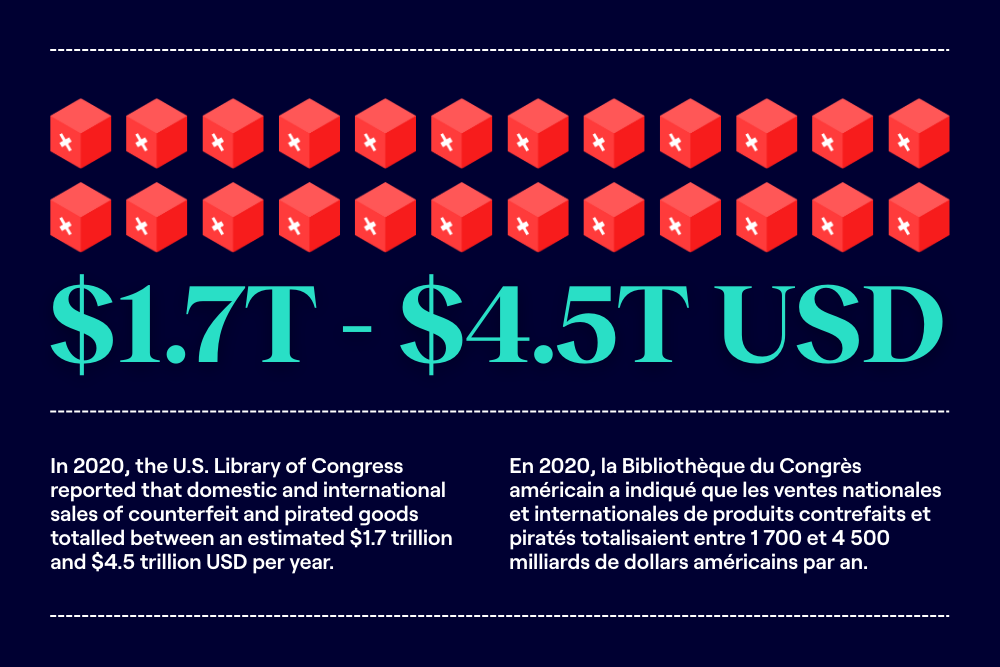
Counterfeit products, or “knock-offs”, are goods that aim to confuse consumers by appearing deceptively similar to the original article, utilising the original article’s brand and name to drive sales, often at a much cheaper price point. Counterfeiting is a significant issue facing brands, and global economies broadly. In 2020, the U.S. Library of Congress reported that domestic and international sales of counterfeit and pirated goods totalled between an estimated $1.7 trillion and $4.5 trillion USD per year.
“Counterfeiting has been around since time immemorial and for obvious reasons. Popular items, whether they’re toys, … consumer electronics or luxury handbags, are susceptible to counterfeiting,” says Graham Hood, Principal at Smart & Biggar, leader of the firm’s Trademarks Practice Group and a leading expert in anti-counterfeiting. He specialises in developing anti-counterfeiting strategies for brand owners, and has worked closely with the Canada Border Services Agency to prevent the unlawful importation of counterfeit goods.
“If the genuine article is making money for the brand owner, chances are someone’s knocking it off. When you have a popular item in the cultural zeitgeist, and the genuine article appears to be flying off the shelves, … there will be a demand for counterfeits. Unfortunately, there are bad actors out there who are prepared to take advantage of that demand and flood the market with cheap knockoffs.”
In recent years, “dupes” have also emerged as competing products that bear aesthetic and functional similarities to the genuine articles, but do not display the brand owners’ marks or names, or even confusingly similar marks or names.
“On the one hand, a counterfeit product is designed to look and feel exactly like the genuine article, using a deceptively similar logo and name. It aims to, at first glance, appear genuine. On the other hand, dupes don’t bear the trademarks or trade names, but their look and function certainly calls back to the genuine article,” says Hood.
“Not every article can be duped – it takes a certain level of established reputation in the appearance of the article to justify demand for a compelling dupe. Dupes aren’t attempting to capitalise on the established mark or name of the product, but rather on its popular appearance or functionality.”
“Dupes serve the same purpose as the original product and are directly competitive. They bear a passing resemblance to the real thing, but they’re not the real thing and aren’t purporting to be the real thing – unlike a counterfeit product, which is there to deceive.”
Exclusivity breeds demand
A key influence behind the popularity of items like Labubus is their scarcity, a common tactic to drive sales. The scarcity principle is a concept in economic and social psychology that suggests people assign higher value to items that are rare or limited, prompting marketing tactics such as drops, time-limits and low stock warnings. Pop Mart has utilised drops in particular to drive high Labubu sales, coupled with a blind box format that means consumers may not even receive their preferred Labubu when purchased. Their strategic alignment with celebrity influencers such as Blackpink’s Lisa in Asia and Rihanna and Kim Kardashian in the U.S. also inspires a FOMO (fear of missing out) mentality for consumers globally.
However, the scarcity tactic and consumer FOMO opens the door for counterfeiters to capitalise.
“The demand for counterfeit goods is driven in part by the exclusivity of the genuine article, and how difficult it is to obtain, whether because of its price, access or otherwise. Certainly, the exclusivity of the genuine article is a contributing factor to the demand for the corresponding counterfeit product,” says Hood.
“[But] when counterfeit goods flood the market, that exclusivity is diminished.”
“No one brand owner is ever going to stop the manufacturing of counterfeit goods, but you can make yourself a ‘hard target’, to deter counterfeiters from knocking off your products. It is important to maintain up-to-date portfolios of all your trademarks in all the jurisdictions in which you do business, and register your logos and other artistic works through the copyright offices in those jurisdictions. Consumer education is another effective tool – some savvy brand owners will go out and explain to consumers the benefits of the genuine articles, how to identify the genuine articles, and the risks or health factors of their counterfeit counterparts.”
Graham Hood – Principal, Smart & Biggar
Reputational damage
A key motivator for consumers when buying counterfeits is accessibility. The genuine article may be sold at an unattainable price point or using aforementioned scarcity tactics. However, consumers who opt for a knockoff are choosing a low-quality product that is potentially hazardous.
“While counterfeit goods may make a product more accessible, it’s important for consumers to understand that they’re not buying the genuine product – they’re buying a product that’s often made in hazardous, unsafe or unsanitary conditions that may be dangerous to their health and safety. [In] making the product more accessible, they … tarnish its reputation, and the goodwill attached to it, because you have a corresponding counterfeit product out there in the market that might look like the real thing, but it is of poor quality … and may in fact be hazardous to one’s health,” says Hood.
Countermeasures for counterfeiting
So, what can brands do to stop counterfeiting?
“Keeping counterfeiters at bay is a difficult challenge, and one that keeps me and our firm very busy. There are a number of things that brand owners can do to protect themselves from counterfeiters,” Hood advises.
“No one brand owner is ever going to stop the manufacturing of counterfeit goods, but you can make yourself a ‘hard target’, to deter counterfeiters from knocking off your products. It is important to maintain up-to-date portfolios of all your trademarks in all the jurisdictions in which you do business, and register your logos and other artistic works through the copyright offices in those jurisdictions. Consumer education is another effective tool – some savvy brand owners will go out and explain to consumers the benefits of the genuine articles, how to identify the genuine articles, and the risks or health factors of their counterfeit counterparts.”
“In many countries, brand owners can also register their rights with customs and law enforcement officials at the border, who can keep an eye out for incoming shipments of counterfeit goods and alert brand owners if they come across such shipments. The brand owners can then take action against the importers,” Hood adds.
United in brand protection
Counterfeiting is not going away anytime soon, but brand owners can take proactive steps to protect their intellectual property, goodwill and reputation. Unity is essential in achieving a global reduction of counterfeiting.
“When it comes to counterfeiting activities, all brand owners, regardless of industry, are seeking the same goal – to stop counterfeiting. We see a lot of cooperation and teamwork among brand owners. Counterfeiting isn’t going to go away through the efforts of individual brand owners. It will take a team effort to stop counterfeiting or at least minimise the harm brought on by counterfeiting to both consumers and brand owners,” Hood concludes.
Sign up to our free newsletter to stay informed, connected and inspired by all things IP.

Featuring